
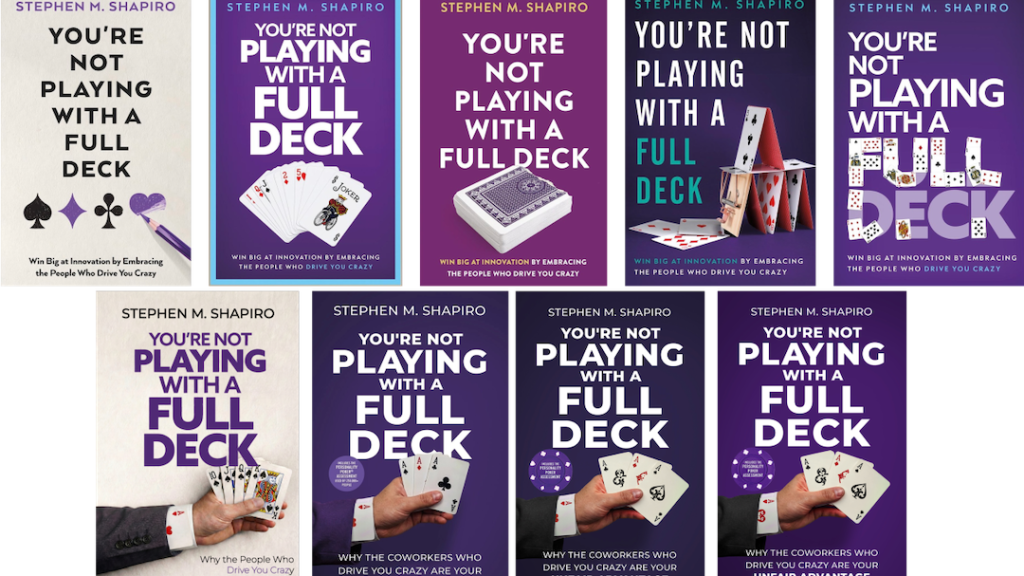
Six months ago, I started designing the cover for my 8th book, and my first self-published one.
In the past, my publisher handled the cover and I simply approved it. This time, every decision was mine.
The book is called You’re Not Playing with a Full Deck. It’s a business book on innovation, collaboration, and culture, built around my Personality Poker card game. The cover had to do two things at once: signal serious business, and still feel playful.
In total, we explored over 100 variations.
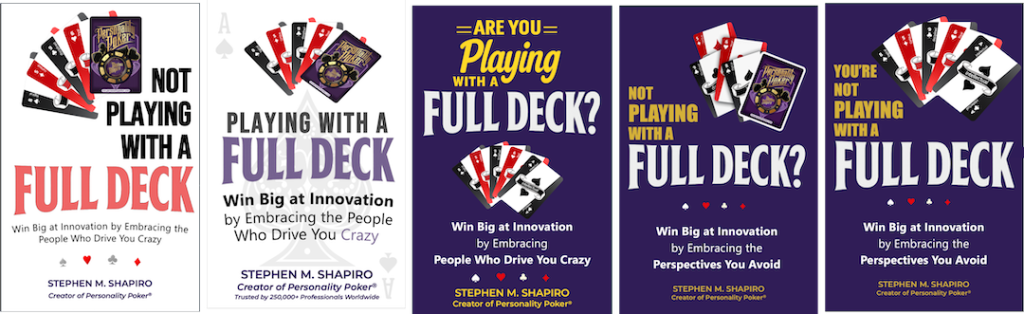
At first, I created my own concepts using the Personality Poker cards, and even changed the title a few times. The feedback was, politely, underwhelming. They were fun, but did not scream, “Hey, this is a business book.”
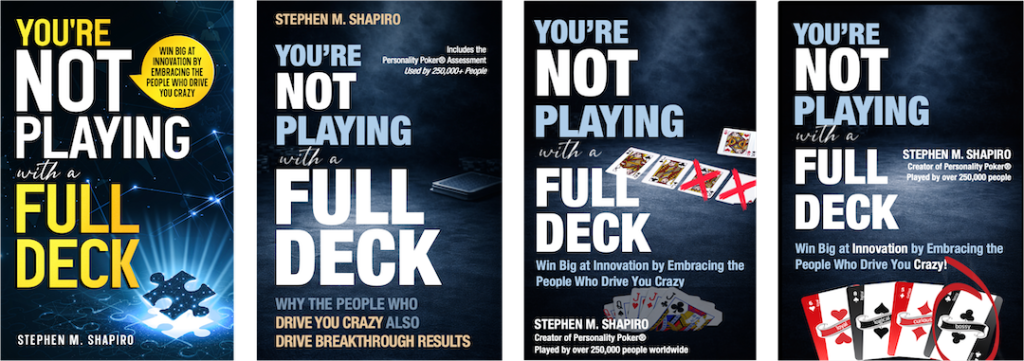
Next, I ran a quick experiment and hired a low-cost designer I’d worked with before. For $25, it felt worth seeing what they’d do with minimal guidance. They created the left-most image. I liked the fonts, but the puzzle piece metaphor felt wrong for this book. I tried building from their idea, but the variations still didn’t capture the spirit. Too dark, and not playful enough.
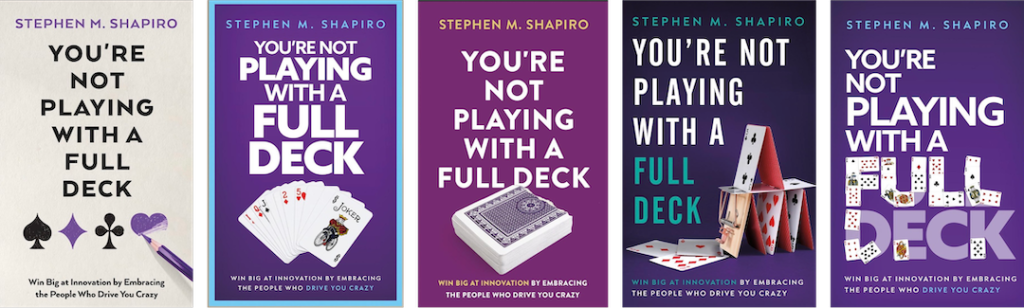
So I hired a well-respected, and expensive, cover designer. He delivered five strong concepts.
Then I did what most authors do: I asked colleagues and clients which one they liked best.
Testing designs with the market is usually a good idea. But unfortunately, no one agreed.
People were passionate, but in opposite directions. Some loved the left-most concept for its simplicity and readability; others found it boring. Some loved the right-most concept because it was clever, while others said it looked messy and unprofessional.
Not knowing which way to turn, I hired an independent book cover reviewer. He delivered a nine-page audit, analyzing each concept and recommending a direction. It helped me get clearer on fonts and color palette.
But it still didn’t solve the core issue. None of the imagery felt right.
Then the breakthrough showed up at 3 a.m.
One night, I woke up with an idea: an ace up the sleeve.
I loved it instantly because the phrase already carries the meaning I want, a hidden advantage that helps you win.
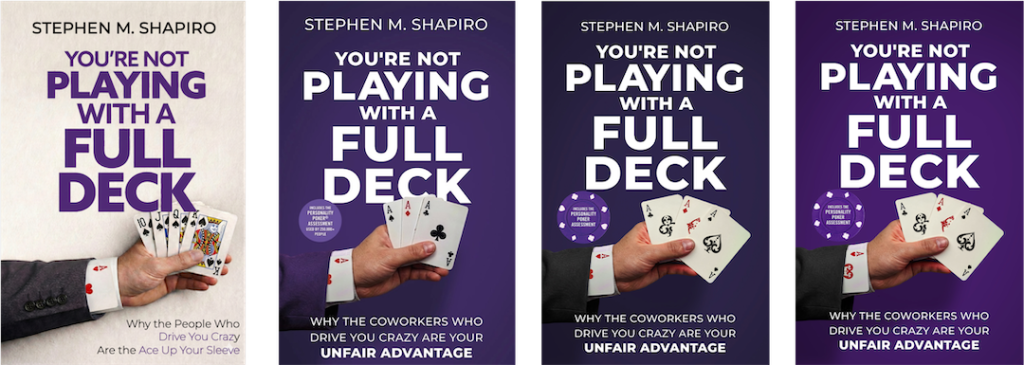
From there, I explored dozens of ace up the sleeve variations, including rapid prototyping with AI. Once I had a concept that felt right, I handed it to the designer to turn into something real and polished.
Along the way, we refined a lot. Lighter background, fewer confusing elements, switching to four aces, replacing the callout with a poker chip, making the hand a bit messier, and adjusting the purple so it pops.
You’ll also notice that both the title and subtitle evolved with the cover. In the end, the subtitle became, Why the Coworkers Who Drive You Crazy Are Your Unfair Advantage. I’m using the phrase ace up your sleeve on the back cover to tie it all together.
The cover on the right is the final one.
Here are the lessons I’m taking with me.
- Work with true professionals. My self-designed cover would have been a failure, and the bargain version would have topped out at fine.
- Don’t rely on the crowd to decide. Most people choose based on personal taste, not what actually makes someone pick up and buy a book.
- If you’re stuck, bring in an independent expert. Even with a great designer, you still have to choose.
- Keep going past good. The ace up the sleeve idea changed everything.
- Use AI as a rapid prototyping tool. It helped me explore directions fast, then hand the best one to a human designer.
- Be flexible. Sometimes the cover drives the subtitle, sometimes the subtitle drives the cover.
- If you’re working on a cover right now, what’s been the hardest part for you?
I hope my experience will be of some help to others.
Thank you to everyone who gave their input during the process!