
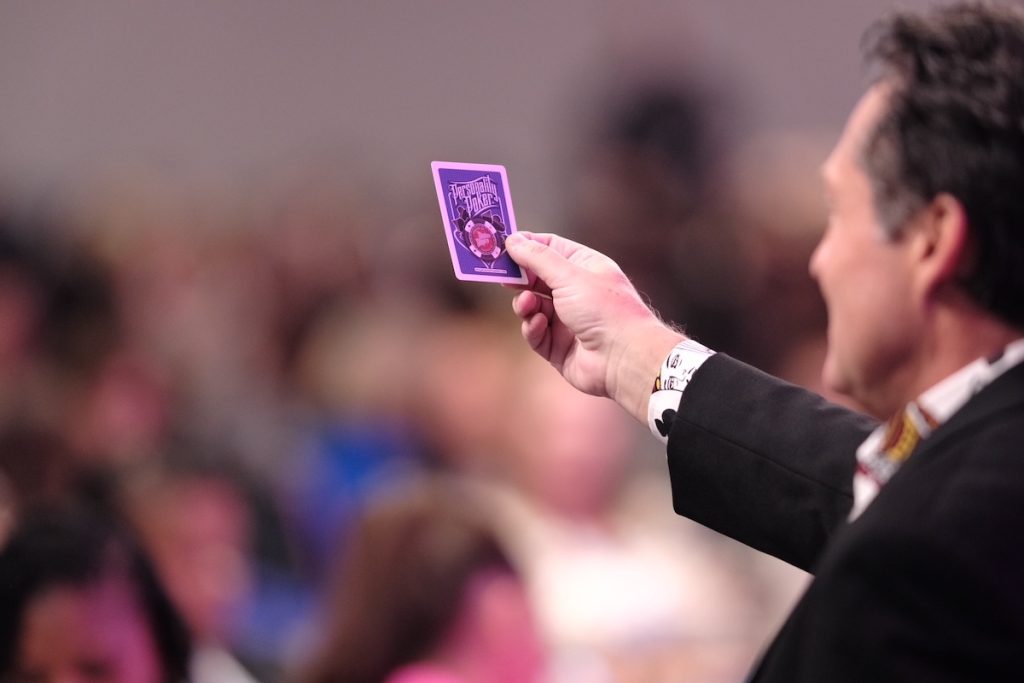
Last Friday I delivered my Personality Poker experience in twelve minutes. The full version runs an hour. It includes card trading, complete with a live demonstration in the crowd, audience interaction, walk-off music, a card fountain finale, and the twelve-minute version kept all of it. I landed at 11:55 on a hard twelve-minute clock, in front of a room full of meeting planners.
Compressing the talk was its own puzzle.
My first instinct was to trim. Take the hour, cut the weakest sections, talk faster. That instinct is wrong, and it produces the twelve-minute version nobody remembers.
The better question is: what is the short version FOR? My hour-long keynote delivers a transformation. My twelve-minute showcase had one job: make a room of buyers experience the product and want more. Different job, different design.
I redesigned rather than trimmed.
Once I knew the job, the cuts made themselves. Content that taught got cut. Content that demonstrated was kept. The audience trading cards to Kenny Rogers is the experience. The framework lecture is homework. I kept the trading and compressed the lecture into a taste.
A short talk is not a small long talk. It is a different animal with a tighter skeleton.
But compression is not the reason I am writing this. The deadline forced me to invent a rehearsal process I will now use for every talk I ever give, at any length. Over three weeks and more than fifty rehearsals, I turned my phone into a speech coach that never gets tired, never flatters me, and catches things no human coach can hear in real time.
YOU CAN LISTEN TO THE RECORDING, BUT YOU STILL WON’T HEAR IT
Here is the entire process, and it costs almost nothing.
Every rehearsal, I hit record on my phone using the voice recorder. I AirDrop it to my Mac and upload the audio file into MacWhisper, which transcribes it into an SRT file. Every phrase I spoke is timestamped to the tenth of a second. Then I give that file to Claude, along with my script, and ask it to tell me the truth.
It told me things I could never feel from inside the talk. One early run clocked a section at 192 words per minute. I thought I was being energetic. I was being unintelligible. In one dress rehearsal, I politely waited for the audience to return to their seats after an activity. That politeness cost 39 seconds of dead air. The fix went straight into the script: start talking the moment the music stops. It knew when I rushed certain sections yet dragged in others.
It measured my pauses. The dramatic hold before my closing line was 2.7 seconds one night and under one second the next. Same speaker, same line, completely different moment for the audience. You think you paused. The file knows. It caught every time I stepped on a punchline, because the timestamps show exactly how much air a laugh line got before I spoke again.
And it caught the single words that kept slipping. I led the project 30 years ago. I created the game 20 years ago. Under pressure, those numbers swapped, and every slip became a drill item until it stopped appearing.
YOUR FAILURES PROVIDE CLUES
Two nights before the showcase, I had my worst rehearsal and could not tell why. The analysis found it in minutes: I was saying my key lines twice. The thesis, twice. The big closing line, twice. Under nerves, I had stopped trusting lines to land once, and my insurance copies added 40 seconds and muddied every big moment.
A few nights earlier, the opposite failure: I skipped lines, and the ending felt hollow. Skipping and doubling turned out to be the same disease. Both showed up in my newest, least-practiced material. The prescription was not another full run. It was ten clean repetitions of one sixty-second passage. The talk was fine. One sixty-second section was the problem, and the data found it.
A human coach might have felt something was off. The file showed exactly what, exactly where, and exactly how much it cost.
THE QUESTIONS ARE THE COACHING
The transcription is not the magic. The questions are. After every run, I asked: Where am I rushing compared to yesterday? How long was the pause before my closing line? Which sections are growing? Did I give the punchline room, or did I step on it? What did I skip? What did I say twice?
Each answer came back with timestamps, so I always knew whether a problem was a feeling or a fact. And because the AI had every previous run, it caught drift I could not: my slowest rehearsals were all after midnight. Tired delivery stretches. The data taught me to trust my daytime tapes and stop panic-editing at 1 a.m.
BUILD A COUNTDOWN, NOT A SCRIPT
For a timed talk, the data also let me engineer the landing. I built gates: when the story ends, the clock should read 7:45. When the trading music starts, 5:55. When I say “Twelve minutes ago, I made you a promise,” 1:15. I rehearsed two endings, a full close and a shorter one, with a decision point at a specific timestamp. On the day, I glanced at the clock at the promise line, took the short close, and landed at 11:50 with the music hitting at 11:55.
That is the difference between hoping you finish on time and engineering it.
TRY IT ON YOUR NEXT TALK
You do not need a showcase or a twelve-minute slot. Take any talk you already give. Record one full run on your phone, or one portion of it. Transcribe it, hand the SRT and your script to an AI, and ask three questions: Where am I rushing? Where is my dead air? How long are my pauses at the moments that matter?
The answers will surprise you. Mine did, even after 30 years on stage. My live talk landed within seconds of the plan, and the audience got my best delivery in years, because for three weeks my phone told me the truth. Over and over again.
Your phone already knows where you are stepping on your punchlines. You just have to ask it.
P.S. The 12-minute video of my showcase will be posted soon!