
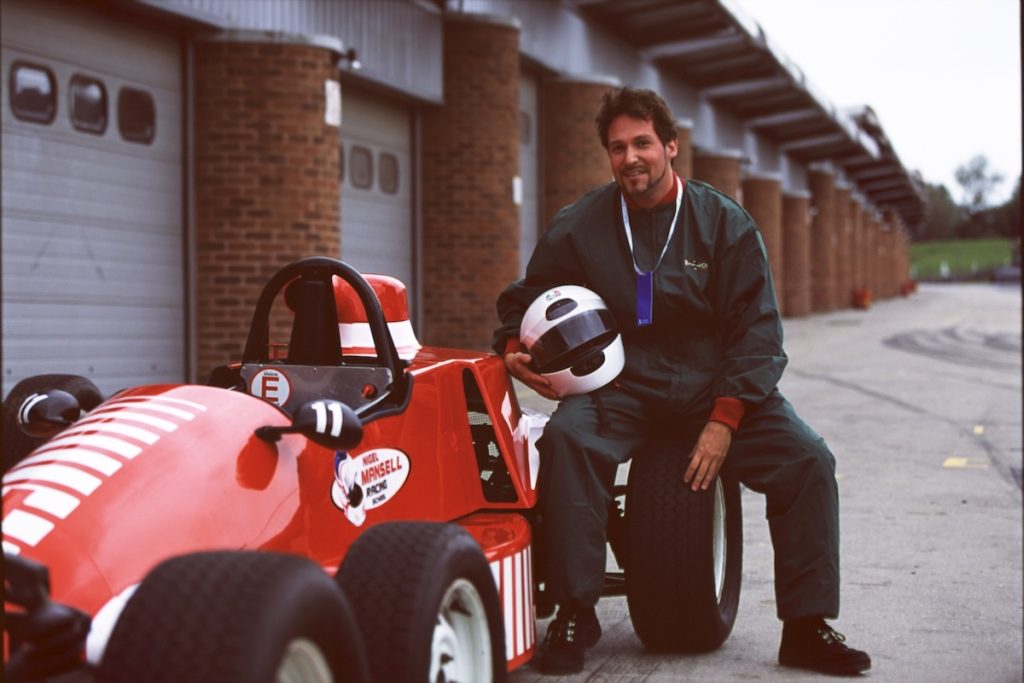
“It’s the brakes.”
While working for the BMW Williams F1 team from 1999 to 2001, I had some amazing experiences.
I went to several Grand Prix, including two at Silverstone. I also visited during testing days at various tracks, including Circuit de Catalunya, where I hung out in the pits.
But maybe the coolest were the driver days. For these, we invited our best Accenture clients to Brands Hatch. In addition to my driving around the track in various race cars, I got to sit in the passenger seat with Jenson Button one year and Juan Pablo Montoya the next. Each time, we were in a modified BMW M5.
The year Button drove me around, it was raining and the course was slick. He was still going at a fast pace and his hands never stopped moving to keep the car on the track. He seemed calm. I wished I were wearing Depends.
When Montoya took me around the track, it felt like he was pushing the car to its absolute limits. I couldn’t imagine going any faster without ending up in a ditch. But apparently, he thought there was plenty of room to go faster.
I asked him what the biggest difference was between an F1 car and a road car. I thought it might be the acceleration or downforce. But he told me, “It’s the brakes.”
He continued, saying the BMW he was driving was a beast that could accelerate well and grip the road relatively well. But the main reason he couldn’t push it to full throttle was that he knew the car couldn’t decelerate quickly enough.
An F1 car can go from 100 miles per hour to a full stop in about 2 seconds. Most sports cars, like a Porsche 911 or a BMW M5, take approximately 3.5 to 4 seconds, depending on conditions. Nearly twice as long.
Going fast depends on being able to slow down.
And the same is true in business.
Sometimes the key to moving faster isn’t a bigger engine. It’s better brakes.
Learn more about my keynote, Stability in an Uncertain World.