
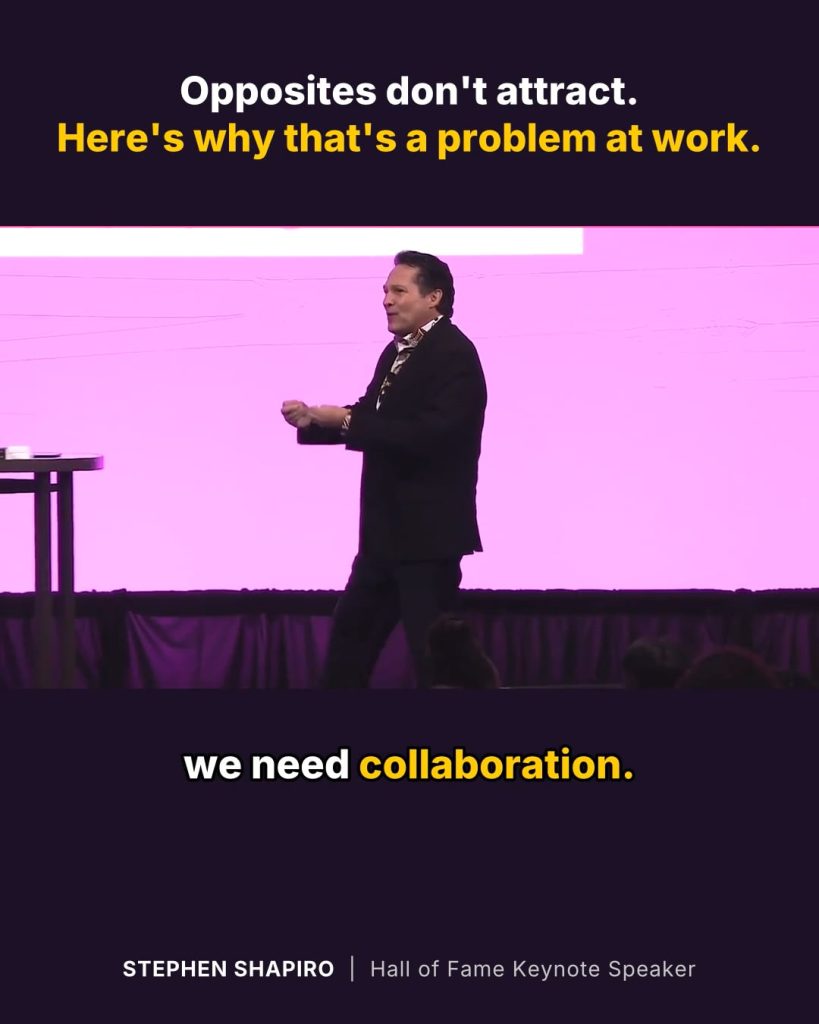
Opposites don't attract.
They detract.
And this kills innovation.
Learn more about Personality Poker.
Video Transcript
I want you to think about the people in your life: your friends, your family, your coworkers. Are they similar to you? Or are they dissimilar?
If you're honest with yourself and you look at the family members you actually get along with, they're probably a lot like you. The coworkers you actually like to work with? They're probably a lot like you.
We've all heard the expression "opposites attract." There is actually irrefutable scientific evidence that opposites don't attract. They detract. They repel. Birds of a feather flock together.
And if you don't believe me that opposites don't attract, just spend some time on Capitol Hill like I have.
Opposites don't attract. In your personal life, maybe that doesn't matter. If your friends are like you, with the same interests and the same values, that's good. Life is easy. You'll enjoy it.
But in the workplace, if you only hire people who fit the mold, eventually the organization will grow mold. You get stale ideas, the same things you've always thought of.
We are in an environment where we need innovation. We need collaboration. We need people working together. And to do that, we need to embrace divergent points of view, divergent perspectives, and divergent personalities.
About 30 years ago, I was leading a 20,000-person innovation practice at the consulting firm Accenture. When I first started, I thought there were some people who are innovative, and then there's everyone else.
But you are all innovative. You are all creative. You all contribute to the success of your organization, just in different ways. If we're going to tap into the power of the collective, we need to understand what your superpower is, and what the superpower of others is.