
It’s that time of year when we set resolutions for 2026.
But maybe one resolution should be to stop making resolutions!
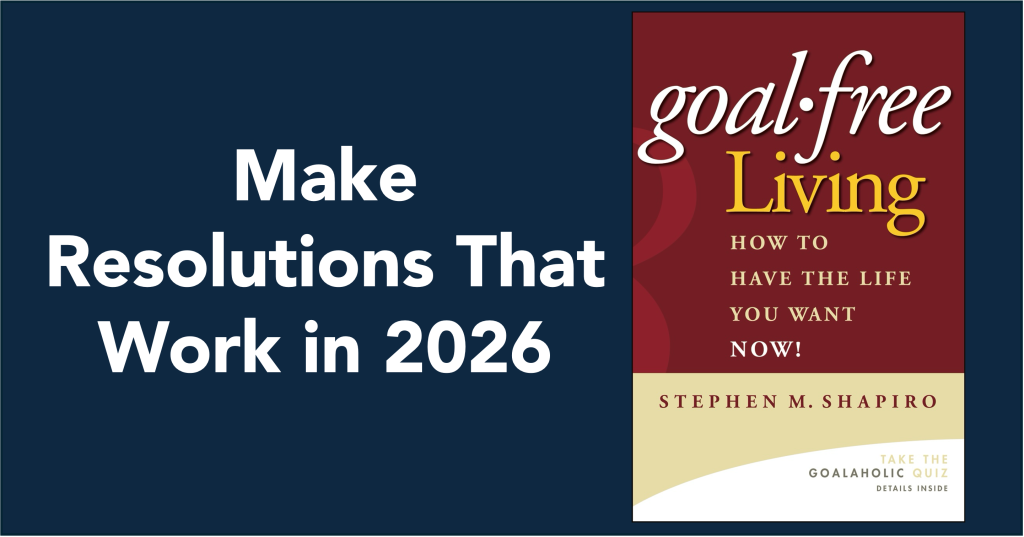
Twenty years ago, Wiley published my Goal-Free Living book.
The premise is that goals are not the key to happiness. Joy does not live in the future, but rather in the current moment.
According to a statistically valid study we did for that book, only 8% of Americans say they always achieve their New Year’s resolutions. Setting a New Year’s resolution is often a recipe for defeat.
The study also found that resolution usage falls with age. Fifty-seven percent of those aged 18–24 set New Year’s resolutions, compared with only 32% of those over age 54 who still set them. Maybe, as we get older, we get wiser, and we identify things that don’t work for us and stop using them.
Among those who plan on continuing the tradition, a third (33%) say they will set just a single New Year’s goal for themselves, while 26% set 2-3 new goals for the year, and 6% will set 4 or more goals for the New Year.
Setting a Resolution this Year? Use Common Sense…or Maybe Not!
Although the basic idea of the end-of-the-year evaluation is a good one, most individuals have had little training in the process of setting realistic goals that will actually increase their happiness. Because of this, most New Year’s resolutions just end up causing increased levels of bitterness, defeat, and unhappiness.
This year, as an experiment, only set goals that bring joy and success. Instead of setting goals based on supposed faults or flaws that your parents or your spouse might want you to correct, why not set goals that can lead to your own individual happiness instead of just conforming to the often misguided, if well-meaning, expectations of others?
According to the study, of those who plan to set New Year’s resolutions:
- 34% say they will set a New Year’s resolution related to their wallet
- 38% say they will set a New Year’s resolution related to their waistline
- 47% say they will set a New Year’s resolution related to their head, such as a self-improvement type goal
- 31% say they will set a New Year’s resolution related to their heart, like a relationship or dating goal.
These are all good areas to focus on in the New Year. However, the danger in this type of goal-setting is that we become focused on where we are going rather than enjoying where we are right now. We sacrifice today in the hope that a better future will emerge, only to discover that achievement rarely leads to true joy.
If you absolutely have to set New Year’s resolutions, here’s some advice:
1. Choose a broad theme rather than specific goals
When most people set New Year’s resolutions, they have specific and measurable results that they want to achieve. Lose 15 pounds. Run a marathon. Quit smoking. In doing so, you become myopically focused and shut down other, potentially more exciting possibilities from appearing in your life.
Rather than resolutions, choose one or two words to describe your next year. It serves as a “theme” for the year rather than a specific goal. For a colleague of mine, one year was about “service,” serving others in whatever way she could to make a contribution. For another person, it was about “flow,” making the year effortless. For a friend who was going through a divorce and a change of career, his theme was “new beginnings.”
2. Choose an expansive and empowering theme
Choose a theme that is expansive, gets your juices flowing, has you excited, and moves you into action. Can’t think of a theme? How about passion, peace, love, friendship, travel, or self-expression? Or maybe new horizons, adventure, or mind expansion might be a good start. Don’t worry if you haven’t named your aspiration yet, it may come out of your theme. Rather than sitting around trying to figure out your passion, choose a direction that will enable you to experience it. If all else fails and you still can’t figure out what your passion is, then make “finding your passion” your theme. I did that one year.
Ask yourself: Why? What is the one word you want to use to describe your next year? A good place to start is with your traditional resolutions. Then ask yourself why. Want to be in a romantic relationship? Look at the reasons why. Do you not like your own company? Do you not have a nice network of friends? If so, instead of dating, maybe “self-love” or “friendship” would be better themes.
3. Reflect on the previous year
Start your resolution-setting ritual on the winter solstice of each year, December 21. Take time to reflect on what you accomplished, the ups and the downs. Be sure to really look at the powerful changes and experiences you had. The key thing is not to beat yourself up. In life, we tend to focus on wins and losses. Successes and failures. When reflecting on the past, don’t focus on whether you failed or succeeded. Instead, ask yourself, Why? Why did you succeed? Why did you fail? Only through this reflection, and through embracing these situations, can you learn and grow. And of course, celebrate your successes.
4. Develop your theme jointly
If you are in a relationship, do these exercises together. Use this as a chance to appreciate each other. Acknowledge one another for their contributions over the past year. And jointly choose a theme that you want to pursue together in the next year. This helps ensure that you are playing the same game, regardless of your individual interests.
5. Remind yourself of your theme
This is a simple compass setting. It does not dictate a specific outcome and does not imply a particular path or plan. Write your theme on a Post-It Note and stick it on your computer screen. Write it on your bathroom mirror. Put it anywhere as a quick reminder to what you are about at this moment in time. Resolutions are things to do. Themes are a way to be.
6. Remain open to new possibilities and to changes in direction at any point in the future
Finally, themes are not set in stone. If the theme you chose is not working, feel free to change it. Themes are designed to help you experience life more fully. You should never feel constrained or limited.
What’s YOUR theme for 2026? Please leave it as a comment.
See you in 2026!
P.S. This was published as a full-page article in the Wall Street Journal in 2011. If you want to dig deeper into the statistics, check out this article.
P.P.S. Coming soon, my 8th book: You’re Not Playing with a Full Deck.