Sometimes the best way to grow your business is to stop telling customers what to do.
That may sound strange coming from someone who writes books, gives keynote speeches, and teaches people how to innovate. But the rise of AI has reinforced something I’ve believed for a long time.
Information is not the same thing as implementation.
And implementation is where the real value lives.
For decades, experts created value by providing answers. Today, answers are everywhere. Business books compete not only with other books, but with podcasts, newsletters, YouTube videos, online communities, courses, and now AI. When people can get answers instantly, information becomes less scarce.
The challenge is no longer finding knowledge.
The challenge is turning knowledge into action.
No matter what business you’re in, you want leverage. Leverage means creating the greatest value with the least amount of effort. Throughout my career as a consultant, speaker, and author, I’ve always looked for ways to package expertise so it can help more people without requiring more of my time.
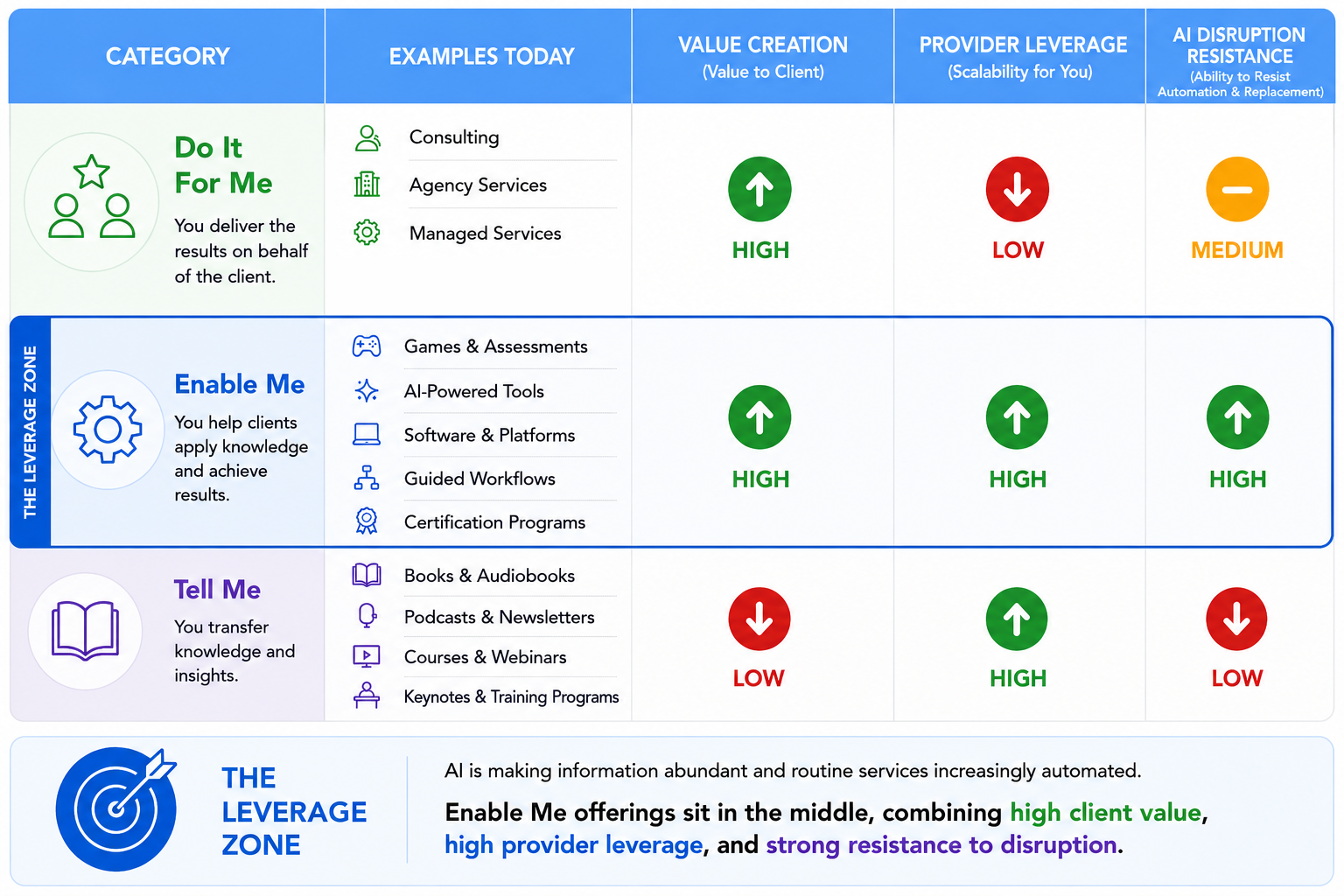
When thinking about products and services, I find it useful to place them into three categories: Tell Me, Enable Me, and Do It For Me.
These categories are not determined by the format of the offering. They are determined by where the work happens. In Tell Me, you provide information. In Enable Me, the client applies that information using a tool, process, product, or system you have created. In Do It For Me, you perform the work on the client’s behalf.
In an AI-driven world, understanding the difference between these categories has become more important than ever.
Tell Me
Tell Me products explain what to do.
Books, articles, courses, webinars, podcasts, speeches, and training programs all fall into this category. Their purpose is to transfer knowledge.
For years, these products were the primary way experts scaled their expertise. Write a book once and sell it thousands of times. Record a course once and distribute it indefinitely.
The challenge is that knowledge has become easier to access than ever before.
Today, anyone can ask an AI system how to launch a product, improve team performance, write a proposal, build a marketing plan, facilitate a meeting, or solve a business problem. Within seconds, they receive a reasonably good answer.
This doesn’t make expertise less valuable.
It changes where expertise creates value.
Information alone is becoming less differentiated. People don’t struggle because they don’t know enough.
They struggle because they don’t act on what they know.
Enable Me
This is where things get interesting.
Enable Me products help people apply knowledge.
Instead of explaining what to do, they make it easier to do it.
A game that generates insights is an enablement tool.
A platform that highlights what is missing and what needs attention is an enablement tool.
A system that helps you see what to do next is an enablement tool.
The value comes from reducing the effort between knowledge and implementation.
Years ago, I created Personality Poker, a deck of specially designed playing cards that helps people understand how they contribute to innovation, collaboration, and team performance. The cards don’t simply provide information about personality styles. They create conversations, insights, and actions.
More recently, we’ve expanded this concept through Full Deck IQ. Rather than producing another report for people to read, the platform helps teams identify what is working, what is missing, and where they should focus their attention. The goal is not to provide more data. The goal is to help teams make better decisions.
Both examples reflect the same principle.
The goal is not to provide more information.
The goal is to help people do something with the information they already have.
Enable Me products create exceptional value because they bridge the gap between understanding and action. They embed expertise into a process, product, or system, making it easier for people to achieve results.
They are also harder to copy. Competitors can duplicate information. It is much more difficult to replicate a well-designed experience, tool, framework, game, or platform.
As AI continues to make knowledge more accessible, organizations and individuals will place greater value on tools, systems, experiences, and platforms that help them turn knowledge into results.
Do It For Me
The final category is Do It For Me.
This is where you perform the work on behalf of the client.
Consulting, outsourcing, agencies, and managed services all fit into this category, although some consultants who simply create PowerPoint slides may be closer to Tell Me.
Traditionally, this has been the highest-value offering because clients receive outcomes without needing to do the work themselves.
The challenge is that it offers the least leverage. Every additional client typically requires additional time and effort. And the cost to the client is reflected in the amount of work required.
Even this category is beginning to change. AI agents can increasingly perform tasks that once required human intervention. Some work that previously fell into the Do It For Me category is becoming partially automated.
But there will always be situations that require judgment, experience, creativity, and human insight.
Where the Opportunity Lives
For many businesses, the biggest opportunity lies between Tell Me and Do It For Me.
People don’t need more information.
They need help turning information into action.
That’s why the future belongs not only to those who possess expertise, but to those who can embed expertise into tools, systems, frameworks, games, platforms, workflows, and experiences.
In a world overflowing with answers, the greatest value comes from helping people achieve outcomes.
The winners won’t be those who tell people what to do.
The winners will be those who make it easier to do it.
Click on the graphic below to see a full-sized version