
The Performance Paradox
Hyper-focusing on goals may actually reduce your ability to achieve them
Keep Your Eye on the Present
Many years ago, I worked with a well-known racing team. Pit crews (at the time), consisted of nearly 20 people who serviced the ultra-fast, high-tech cars – refueling, changing tires, and performing required maintenance in a matter of seconds. The crew members continually shifted positions to find the best combination for the optimal configuration of the team. As they practiced, they used a stopwatch to measure their time to milliseconds. Yet, ultimately, no matter how hard they tried, they couldn’t work any faster. They had hit their performance plateau.

Then, they tried a new approach. They decided not to focus solely on how fast they go, but rather on their style. Now, their movements became more significant than their speed. Astonishingly, the crew shaved several tenths of a second off their best time, even though they “felt” they were moving more slowly. This experiment reinforces the concept that the more you focus on your goals, the less likely you are to achieve them. By worrying about the future, you take your eye off the present. Sometimes to go faster, you must not focus on speed.
Stress Kills Intellectual Activities
In higher intellectual activities, the results are even more pronounced. Take the true story of a high school student who became increasingly anxious over passing her upcoming final exam in math, always her weakest subject. She studied hard, all the time focusing on her goal of passing her exam. In spite of her efforts, she failed. She pleaded with her teachers to give her one more chance. They did. This time, instead of concentrating on the goal, she used a powerful creativity technique.
Her first conscious thought each day when she awoke was to visualize herself as Condoleezza Rice, the U.S. Secretary of State, a very successful, highly educated woman. Dr. Rice wouldn’t worry about a high school math exam, right? By imagining she was someone else, she stopped agonizing and gained more confidence daily. By focusing on the present rather than the result, she scored a 93%, her greatest performance with less effort.
Dare to Be Different
Does this also apply to sales? Can we perform better when we don’t focus on our sales goals? A woman’s clothing store had a competition to determine who among its employees could sell the most in two months. The winner would receive a bonus and, possibly, a raise. All had their eyes on the prize, except for one sales rep who decided on a different approach. Instead of trying to make a sale, she zeroed in on serving the customer. If a customer needed help for eight hours to pick out a blouse, that’s what she would do. If she felt customers would find a better product at a competitor, she would send them there. After two months, this sales person who was not trying to make sales outsold everyone else by a significant margin.
We have seen similar results in many sales and service organizations. We all know (and believe) the expression, “You get what you measure.” But a serious question arises: will you get what you want? Often, targets and goals create stress and dysfunctional behavior.
Less Motivation, More Performance
The concept of reducing goal-obsession to improve performance is not new. In the early 1900s, Robert Yerkes and J.D. Dodson developed the eponymous Yerkes-Dodson Law. The premise is performance increases relative to motivation only to a point, after which performance drops. Typically, it is drawn as an inverted U-shaped curve.
If you lack motivation, the result is low performance. This is not surprising. As your motivation increases, your performance increases – to a point. This point is the sweet spot of optimal performance. Then, as you become more goal-obsessed, performance paradoxically decreases. Goals increase stress and cause you to fixate on the future rather than the present.
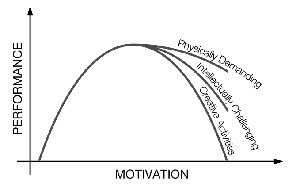
Yerkes and Dodson suggest that different tasks require different levels of motivation. For example, physically demanding tasks often require higher levels of motivation. This explains why professional athletes are inclined to be very goal-driven. Even so, as demonstrated by the pit crew example, too much goal orientation will hurt even athletic performance. In 2004, the New England Patriots broke the records for the longest winning streak in NFL history – 20 games in a row. At a press conference after the game a reporter asked the team’s coach, Bill Belichick, to comment on this winning streak. He replied, “We did not have a 20-game win streak. We had 20 one-game win streaks.” His philosophy was for the team to play each game to the best of its ability. Setting your sights too far ahead is a sure recipe for failure.
Creativity Has its Own Rewards
Within the business world, Yerkes and Dodson found that intellectually challenging tasks required lower levels of motivation. The more creative the work, the less motivation required to hit peak levels of performance. Studies reveal that creativity diminishes when individuals are rewarded (externally motivated) for doing their work. Why? The desire to achieve the goal overtakes the personal interest in the endeavor. A myopic focus on the outcome overshadows the intellectual stimulation of the process. As a result, risk taking becomes reduced and creativity vanishes.
“Working hard” may not be the best way to improve productivity and creativity. Maybe it isn’t even “working smarter.” As we have seen, perhaps the answer lies in trying less. To create a pervasive culture of innovation, you must first create an environment of performance and motivation. Achieving this is often, paradoxically, the result of less, not greater, effort. Although goals and performance targets are useful tools, they can also have a detrimental impact on results. When people are too future-fixated, their creativity and overall performance diminish. Find the sweet spot of optimal performance, and you will undoubtedly see an increase in employee productivity, creativity, and satisfaction – all with less effort.
***
P.S. My core work is innovation. To innovate at peak levels, it’s critical to understand the Performance Paradox. In fact, I have a corollary to the Performance Paradox called “The Solution Paradox” which says, paradoxically, the more you focus on finding solutions, the less likely you are to find the best solutions. Instead you need to stop and focus on the problem/opportunity. Reframing the opportunity is critical to revealing hidden solutions. I talk about The Performance Paradox and The Solution Paradox in my latest book, Invisible Solutions: 25 Lenses the Reframe and Help Solve Difficult Business Problems.
This article was first published in 2006 and is based on the content from Goal-Free Living.