
When organizations hire a keynote speaker, they often focus on the event itself. Will people enjoy the presentation? Will the speaker get good ratings? Will there be a standing ovation?
Those are all reasonable questions, but I think they miss the point.
The real question is: what will be different after the event?
I’ve delivered over 1,000 keynote presentations in more than 50 countries, and one thing I’ve learned is that there is often a huge disconnect between what organizations measure and what actually matters. Most event planners evaluate success based on what happens in the room. I think success should be evaluated based on what happens after everyone leaves the room.
A keynote should not be the end of a process. It should be the beginning.
The Problem with Standing Ovations
Don’t get me wrong. I like standing ovations. I like high ratings. Every speaker does.
But neither of those things tells me whether I made a difference.
A standing ovation tells me how people felt at that moment. It doesn’t tell me whether they changed anything when they got back to work. It doesn’t tell me whether they had better conversations, made better decisions, or approached challenges differently.
Years ago, I stopped judging my success by what happened immediately after a keynote. Instead, I started paying attention to what happened months and years later.
That’s where the real story is.
A Thirteen-Year Test of Impact
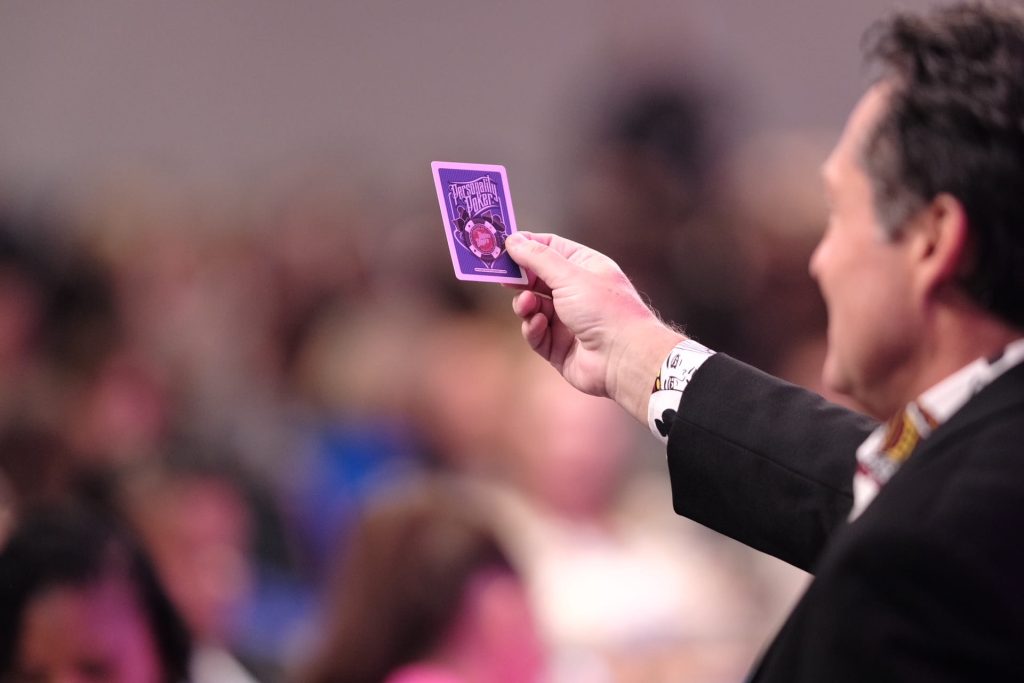
About thirteen years ago, a company hired me to deliver a Personality Poker session for roughly 500 employees.
The event was energetic and engaging. People had fun. But if you had asked me the next day whether it was successful, I honestly wouldn’t have known. Success is not measured by what happens on the stage.
What made it successful was what happened afterward.
Years later, I reconnected with the CEO. He told me that Personality Poker had become one of the most important leadership tools in the organization. People used the language from the cards in meetings. Teams talked about whether they were having the right kind of conversation. Were they brainstorming? Analyzing? Executing? Reporting status?
The concepts became part of the culture.
The comment that really stuck with me was when he told me that on his desk, he kept only four things. Two were personal. One was a deck of Personality Poker cards.
Think about that for a moment.
Thirteen years later, he was still using the tool from a keynote presentation.
Recently, the company purchased 2,000 additional decks and is now implementing Full Deck IQ throughout the organization.
That’s the kind of impact I care about.
The Hotel Encounter I’ll Never Forget
A few years ago, I was walking through a hotel when a woman stopped me.
She looked at me and asked, “Are you the guy who created Personality Poker?”
I told her I was.
She then explained that she had attended one of my keynote presentations about ten years earlier. What happened next caught me completely by surprise.
She told me she still uses the concepts today.
In fact, she still had the original Personality Poker cards from the event.
Later that day, she texted me a picture.
Over the previous decade, she had moved to five different countries. Through all of those moves, those cards stayed with her. She told me they were one of the few professional tools she had carried because they had been so valuable in helping her work with teams and lead people.
As a speaker, that’s one of the greatest compliments I’ve ever received.
Not because she remembered me.
Because she remembered the ideas.
More importantly, she was still using them.
If a YouTube Video Feels the Same, Why Hire the Speaker?
One of my strongest beliefs about keynote speaking is also one of my most controversial.
If watching a YouTube video of a speaker feels essentially the same as seeing that speaker live, then I question the value of hiring them.
Today, content is everywhere. We can get ideas from books, podcasts, articles, videos, and AI tools. Information is abundant.
A live keynote should offer something different.
It should create an experience.
When people describe my sessions, they often tell me they felt more like training sessions than keynote speeches. They don’t mean that as criticism. They mean that they weren’t sitting passively in their seats listening to someone talk for an hour.
They were participating.
I’ve delivered presentations to audiences of 2,000 people where attendees later told me they felt personally involved in the experience. That’s exactly what I want.
The audience should not feel like spectators.
They should feel like participants.
I’m Not Really a Speaker
Whenever people ask what I do, I usually say I’m a keynote speaker because it’s the easiest description.
But if I’m being honest, that’s not how I think about my role.
Speakers speak.
My goal is to engage.
I want people thinking, responding, moving, questioning, discussing, and participating. I want them to feel like they’re part of the experience rather than simply watching it unfold from a distance.
Even in a large ballroom, the experience should feel personal.
The audience should feel connected to each other, connected to the content, and connected to the possibilities that emerge from the conversation.
A keynote should feel like a dialogue, even when one person is standing on the stage.
The First Question I Ask Every Client
People are often surprised by one of the first questions I ask before an event.
I don’t start by asking what they want me to cover.
I ask what they want to be different six months after the event.
What conversations should be happening? What behaviors should change? What would success look like?
Sometimes the answers lead to additional resources or tools. Sometimes they don’t. There are many ways to reinforce learning that cost little or nothing.
The important thing is having the conversation.
If we don’t know what success looks like six months later, it’s very difficult to design an experience that creates lasting impact.
What You Should Expect From a Keynote Speaker
When you hire a keynote speaker, you should certainly expect someone who is engaging, professional, and capable of holding an audience’s attention.
But don’t stop there.
You should also expect someone who thinks beyond the event itself. Someone who understands that the goal isn’t applause. The goal is action.
The best keynote speakers don’t simply deliver content. They create experiences that change how people think, communicate, and work together. They provide a shared language that continues long after the conference is over.
Years later, people may not remember every story or every slide.
But if the keynote was successful, they’ll still be using the ideas.
And in my opinion, that’s the ultimate measure of success.