
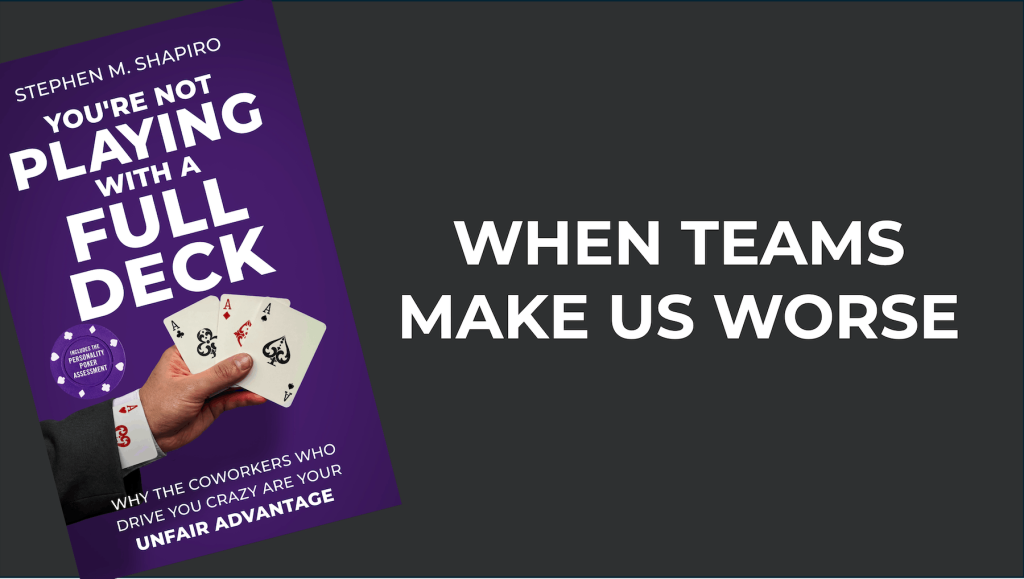
We’ve been told for years that teams make us better. Bring together people with different perspectives, encourage them to collaborate, and the group’s collective intelligence should produce a better result.
Sometimes it does. Sometimes it does the opposite.
Recent research highlighted by Knowledge at Wharton found that teams performed as much as 60% better than the strongest individual on some tasks. But on others, teams performed three times worse.
That’s a huge difference. The question, then, isn’t whether teams outperform individuals. It’s: When do teams make us better, and when do they make us worse?
The answer appears to depend heavily on the nature of the work and the conditions under which people are asked to collaborate. And that closely mirrors something I’ve been teaching for years through Personality Poker: before deciding who should do the work, understand the environment in which the work will be done.
In other words, rules before roles.
Rules Before Roles
We tend to focus on putting the right people on the right tasks. But performance depends on something else that is often overlooked: the environment in which we ask people to do the work.
Think about two extremes. Some work is highly structured. There are clear rules, established processes, defined expectations, and perhaps even an objectively correct answer. Other work is much more open-ended. The destination may be unclear, the process needs to be invented along the way, and there may be many possible answers.
Those environments require very different ways of working.
This is one of the most interesting findings from the Wharton research. Teams tended to perform particularly well on problems where the correct answer could be recognized and verified. Under those conditions, adding people increased the likelihood that someone would discover the answer and that the group could recognize its validity.
But collaboration became less beneficial on open-ended tasks where there was no objectively verifiable best answer. Additional people could introduce more uncertainty, disagreement, and inefficiency rather than improving the result.
In other words, teamwork itself isn’t inherently good or bad. The environment changes the value of the team.
Red Cards vs. Black Cards
Years ago, a leadership program at Eckerd College in Florida conducted an exercise that demonstrated a similar principle. They tested people to see whether they liked working within rules or preferred breaking them.
In Personality Poker, red cards tend to prefer flexibility and doing things differently. Rules can feel limiting and restrictive. Black cards, on the other hand, tend to prefer structure and doing things better within rules.
You might therefore assume that the obvious approach would be to put the red cards in creative roles and the black cards in implementation roles. But the answer isn’t that simple.
Participants were divided into designers and builders. The design task was highly structured, with seven rules that had to be followed. The build task was almost completely unstructured.
One team followed the conventional wisdom: red cards designed and black cards built. Another mixed the two styles together in both roles. A third did what seemed like the opposite of what should make sense: black cards designed and red cards built.
Which combination was most effective?
The third team won by a mile.
The reason was that the environment mattered more than the label attached to the task. The design activity sounded creative, but it operated within a highly structured environment. The black cards thrived because the rules were clear. The build activity sounded like execution, but it was actually wide open. The red cards thrived because they had the freedom to figure things out as they went.
The lesson wasn’t that black cards are better designers or red cards are better builders. It was that our conventional categories of “creative people” and “execution people” can cause us to miss what really drives performance.
The task tells you what needs to be done. The rules tell you the conditions under which it will be done.
And those conditions can completely change who is best suited to the work.
The Personality Poker Connection
This is where the Wharton research and Personality Poker become particularly interesting together.
The Wharton researchers didn’t study Personality Poker, and their research shouldn’t be presented as scientific validation of the methodology itself. But their findings provide independent scientific support for a central principle behind it: You cannot determine the best way to organize people without considering the nature and conditions of the work.
Personality Poker gives leaders a practical language for doing exactly that.
The four suits represent four different orientations. Diamonds are creative and like ideas and experiences. Spades are analytical and like facts and data. Clubs plan the work and work the plan. Hearts focus on relationships and people.
But there’s another dimension that is equally important. The red suits, Diamonds and Hearts, tend to prefer more flexibility and freedom. The black suits, Spades and Clubs, tend to prefer greater clarity and structure.
This means simply matching people to tasks isn’t enough. A Diamond may be highly creative, but they can excel at execution if the usual constraints that limit their flexibility are removed. A Club may be known for execution, but put them in a brainstorming session with a well-defined process and they can be incredibly creative.
Same person. Same capabilities. Different rules. Different performance.
Stop Trying to Fix the Person
This has another important implication for leaders. When someone struggles, we often assume something is wrong with the person. Maybe they lack the necessary skill. Maybe they aren’t motivated. Maybe we gave them the wrong assignment.
Sometimes the problem is none of those things. They may simply be operating in an environment that fights against the way they naturally work.
I experienced this in my own business when I hired Sean, a black card with deep project management experience, to run a complicated client engagement. On paper, it was a perfect match. Project manager. Complex project. What could go wrong?
Quite a lot, as it turned out.
I gave Sean the kind of environment I personally love. I gave him freedom, stayed out of his way, and expected him to figure out the best approach. I thought I was empowering him. Instead, he struggled.
Eventually he told me what was missing. He needed clearer milestones, decision frameworks, expectations, and success criteria. I had given him a black-card role in a red-card environment.
Once I added the structure, his performance changed dramatically. I hadn’t changed the person or the assignment. I changed the rules.
More People Aren’t Always Better
There is another lesson here that connects directly with the Wharton findings.
One of the central principles of Personality Poker is that people who think differently from us can compensate for our blind spots. Cognitive diversity matters. But that doesn’t mean the solution to every problem is adding more people to the room.
In fact, in the Eckerd exercise, the team that mixed red and black cards in both roles performed the worst. Without the tools to understand and leverage their differences, their diversity created conflict instead of value.
That’s an important distinction. Diversity is potential. It isn’t automatically performance.
The Wharton research demonstrates something similar at the level of collaboration. Adding more minds to a problem can dramatically improve performance under the right conditions. Under the wrong conditions, the team can actually perform worse than an individual.
So the goal isn’t maximum collaboration, and it isn’t maximum diversity at every moment. The goal is the right people, working in the right way, under the right conditions, at the right time.
What It Really Means to Play with a Full Deck
This helps clarify what I mean when I tell organizations they need to “play with a full deck.”
It doesn’t mean every meeting needs an equal number of Diamonds, Spades, Clubs, and Hearts. It doesn’t mean everyone should participate in every decision. And it certainly doesn’t mean that teams are always superior to individuals.
It means recognizing that no single way of thinking or working is appropriate for every situation.
Sometimes you need the Diamonds expanding possibilities. Sometimes you need the Spades scrutinizing assumptions. Sometimes the Clubs need to stop the conversation and move everyone toward a decision. Sometimes the Hearts are essential because even the technically correct solution will fail if people don’t embrace it.
And sometimes the best thing you can do is let someone work alone.
The Wharton research gives us compelling evidence that team performance depends on the characteristics of the work and the conditions surrounding collaboration. Personality Poker adds a practical framework for understanding the people inside those conditions.
So before your next project, meeting, or important decision, don’t start by asking who should be on the team. Start with the rules.
How structured is the work? How ambiguous is the problem? Is there a verifiably correct answer, or are we exploring possibilities? Do we need collaboration at this stage, or would individuals working independently produce better results?
Only then should you move to the roles. Who thrives under these conditions? Which perspectives do we need? Who should lead? Who should contribute? And perhaps just as importantly, who doesn’t need to be involved right now?
Because playing with a full deck doesn’t mean playing every card.
It means knowing which cards to play, and creating the right conditions for them to perform at their best.