
The other day, I gave a presentation to the Central Florida chapter of the National Speakers Association on the future of speaking. One of the points I shared was that, in a world where content is increasingly easy to access, speakers need to think beyond what happens during their time on stage.
A great speech is not the goal. Creating something that continues to matter after the event is over is…
A few years ago, I gave a 90-minute keynote for 400 engineers in the U.S. Air Force.
The first 45 minutes were great. People were laughing, participating, and clearly having a good time. The room had energy. Then, somewhere in the second half, everything changed.
The room got quiet.
The laughter stopped. The energy dropped. It felt as though all the oxygen had been sucked out of the room.
Afterward, people came up to tell me the session was amazing. I was confused. I asked about the second half because I assumed that was where I had lost them.
They told me, “The first half was fun. The second half hit us in the gut. You said things we needed to hear, even though we did not want to hear them.”
That experience has stayed with me because speakers are often taught to measure success by the response in the room. Did people laugh? Did they participate? Did they give you a standing ovation? Did the evaluations come back with high scores?
Those things are nice. But they can also be misleading.
A standing ovation is not an outcome.
Interactive, Memorable, and Impactful
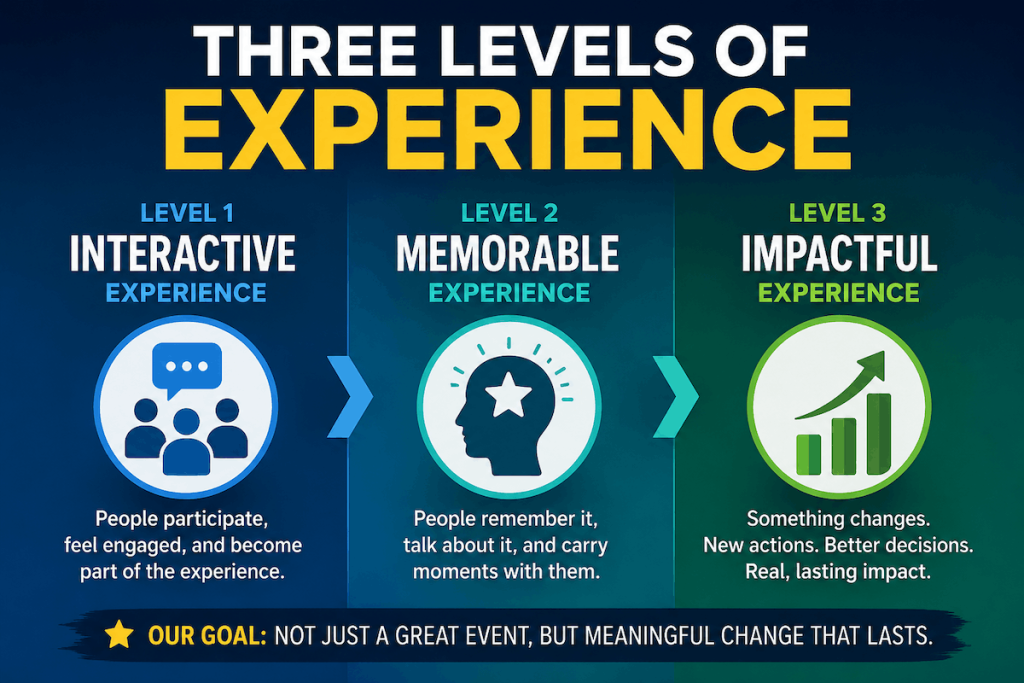
I think about audience experiences in three levels.
The first level is interactive. People are participating rather than simply listening. They may answer questions, discuss an idea at their tables, vote in a poll, or take part in an activity.
For me, an interactive experience is one that cannot be fully replicated by watching a video on YouTube. If someone can get essentially the same experience by watching your keynote online, there is little reason to bring everyone together in a room. The value of a live event is that people are part of it. They are reacting to one another, making choices, having conversations, and experiencing something together in real time.
The second level is memorable. People talk about the experience afterward. They remember a story, an activity, or a moment that made them see something differently.
The third level is impactful. Something actually changes after the event. People use a tool. They make better decisions. They have different conversations. They approach their work together in a more useful way. The event creates something that continues after the speaker is gone.
That third level is harder to achieve, but it is also where the real value lies.
The Woman in the Hotel Lobby
I was standing in a hotel lobby when a woman approached me. She asked, “Are you the guy who created Personality Poker?”
Nobody ever recognizes me in public, so I was a little surprised. I said yes.
She told me that she had participated in one of my sessions a decade earlier. Since then, she had moved to five different countries. Out of everything she had accumulated over those years, one of the things she had kept through every move was her Personality Poker cards.
That night, she sent me a photo of them.
That is what a memorable experience looks like. It is something people continue to talk about, remember, and carry with them long after the event is over. In her case, one keynote experience stayed with her for a decade and across five international moves.
That matters. But memorable is not the same as impactful.
The CEO Who Kept the Cards on His Desk
Last year, I did another event for an organization where I had led a Personality Poker session over a decade earlier.
The CEO and I had barely spoken in the years since that event. When we reconnected, he told me that Personality Poker had been the single most important business tool he had used during his 13 years as CEO.
He said there were only four items on his desk. Two were personal. One was business-related. The other was a Personality Poker deck.
Whenever someone came into his office, he would use the cards to begin a deeper conversation.
That is an impactful experience. The session did not just create a good memory. It introduced a tool that became part of how the CEO led the organization, how he engaged employees, and how people had conversations about their strengths and missing perspectives. They recently bought thousands of decks of cards to further drive impact throughout the organization.
The difference is important. A memorable experience is one people talk about for years. An impactful experience is one that changes something, creates value over time, and can be measured.
In this case, the CEO could point to over ten years of using the tool in his organization. He could describe its role in conversations, leadership, and decision-making. That is a far more meaningful measure than whether people enjoyed the original keynote.
Do Not Think of the Speech as an Event
Most speakers, and most clients, think of a speech as an event.
There is an agenda. A room. A stage. A time slot. A speaker. Applause. Then everyone goes home.
That is too small a way to think about it.
A speech should not be the event. It should be the launch.
The question is not simply, “What will happen during the speech?” It is, “What are we launching with this speech that will continue to create value after the speaker leaves the stage?”
An event gives you something difficult to create any other way. It brings a large group of people together at the same time, focused on a common issue. It gives an organization shared language, shared energy, and a shared starting point.
That makes it the ideal moment to launch something.
It might be a new way for teams to talk about a challenge. It might be a framework leaders use in future meetings. It might be a tool that helps people make better decisions or work together more effectively. It might be a set of conversations that need to continue long after the event is over.
The speech is not the destination. It is the starting point.
The Conversation Before the Event Matters Most
That is why the most important conversation may be the one that happens before the event.
When a client says, “We want to hire you for a keynote,” the conversation should not end with what you will say, how you will say it, the audience size, or the AV requirements.
It should include what they want to launch.
What needs to be different afterward? What conversations need to continue? What challenges are they trying to address? What will people need in order to apply the ideas once they are back at work? How will the organization know whether the event created real value?
Without that conversation, even a powerful keynote can become a pleasant memory that fades by the following week.
With that conversation, you can design the speech around something more meaningful than audience reaction. You may decide the audience needs a common language they can use in future meetings. You may introduce a tool that managers can use with their teams. You may create discussion questions that leaders can continue using after the event. Or you may help the client identify one or two measures that will show whether the message led to something useful.
The speaker does not have to own all of that work. In many cases, the client is perfectly capable of carrying it forward. But it is much easier for them to do so when the next steps are considered before the audience ever enters the room.
Giving People Something They Can Use Afterward
For me, Personality Poker became one way to extend the value of a live experience. It gave people something tangible they could take back to their teams and use to have better conversations.
More recently, I developed Full Deck IQ for a similar reason. It helps teams see where they are strong, where important perspectives may be missing, and where those gaps may be affecting collaboration, innovation, or decision-making.
The point is not that every speaker needs to develop a card deck, a diagnostic, a platform, or a certification program.
The point is to think beyond the event itself.
What can people use after you leave? What will help them apply the idea in a meeting, a decision, a conversation, or a project? What will keep the message alive after the energy of the event fades?
Sometimes the answer will be a tool. Sometimes it will be a question, a habit, a framework, or a series of conversations. The format matters less than whether it helps the client convert a moment of insight into something useful.
The Real Measure of Success
Today, information is cheap. Anyone can watch a video, read an article, download a framework, or ask AI for an answer.
What they cannot get from a video or an AI-generated summary is a shared live experience that creates momentum, emotion, connection, and commitment.
That is the opportunity for speakers.
But an amazing moment in a ballroom is not enough. The goal is not simply to create an interactive experience or even a memorable one.
The goal is to launch something that keeps working after the room is empty.
The next time you are preparing for a keynote, do not just ask, “How can I make this more engaging?”
Ask, “What are we launching with this speech, and what will still be happening long after I leave the stage?”